Currently viewing the category: "weight gain"

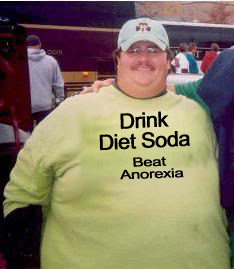
Put down that can of Diet Coke, dear reader.  It can be harmful to your health. So says a study conducted earlier this year, that showed diet soda drinkers to be at an increased risk for stroke.

Some believe that by drinking the diet variety of soft drinks, they bypass the harmful effects of sugar, thereby making a healthier choice in their beverage selection. But many of us have suspected that diet sodas have hidden harms, despite the inability of nutrition researchers to find them. Some recent studies, however, have shown that diet soda drinkers not only gain weight, but they do so even more than drinkers of regular soda. Doh! And now stroke.
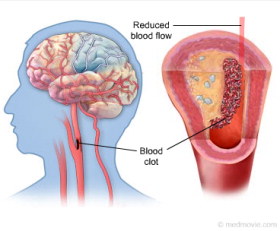
Researchers followed 2,564 people in the large, multi-ethnic Northern Manhattan Study (NOMAS). They collected soda drinking habits and followed the subjects for 9.3 years on average. They found that people who drank diet soda every day had a 61% higher risk of vascular events than those who reported no soda drinking. Researchers accounted for participants’ age, sex, race or ethnicity, smoking status, exercise, alcohol consumption and daily caloric intake. And even after researchers also accounted for patients’ metabolic syndrome, peripheral vascular disease and heart disease history, the increased risk persisted at a rate 48% higher.

Researchers believe the reason for the increased stroke risk has to do with sodium intake. A separate study showed that an increased intake of sodium also increased the risk of ischemic stroke (when a blood vessel blockage cuts off blood flow to the brain). Diet sodas contain between 35 and 40 milligrams of sodium per can. Not a massive amount by any means, but when multiplied by the numbers that many individuals imbibe in one day, and the sodium intake starts to approach dangerous levels.

The second study showed that individuals who consumed more than 4,000 milligrams of sodium a day had twice the risk of experiencing a stroke when compared to individuals with an intake of less than the recommended limit of 1,500 milligrams of sodium per day. Only a third of participants met the current U.S. Dietary Guidelines for Americans that recommend daily sodium intake fall below 2,300 mg, or about a teaspoon of salt. Only 12% of subjects met the American Heart Association‘s recommendations to consume less than 1,500 mg a day. Average intake was 3,031 milligrams.

Well I’m sure you can imagine me shaking my head in contempt. I just don’t have tolerance for the liquid sugar habit picked up by the majority of Americans. If you can’t see the writing on the wall–sodas (both regular and diet) cause negative health consequences like obesity, diabetes, rotten teeth and now stroke–then so be it. But stop thinking that diet soda is a healthier alternative to regular soda, because it’s not.

I’ve gotten to experience something very interesting over the last couple of weeks.  Resulting from my posts on childhood statin recommendations and parental responsibility for childhood obesity, I’ve gotten numerous replies, comments and tweets that have both commended and criticized my views.  Being all for intelligent discussion, I’ve welcomed the responses; but something has become very clear to me: People who are attached to a particular point-of-view will fill any holes with their own interpretations and opinions,quite apart from anything that has ever been said or implied.  It’s an interesting phenomenon.  So as promised, I will continue presenting my viewpoint on obesity in general, and specifically, childhood obesity, so I can fill those holes myself, and keep my thoughts from being assumed by others.

Let me begin with the obvious: What is obesity?  From Wikipedia:

Obesity is a medical condition in which excess body fat has accumulated to the extent that it may have an adverse effect on health, leading to reduced life expectancy and/or increased health problems.  Body mass index (BMI), a measurement which compares weight and height, defines people as overweight (pre-obese) if their BMI is between 25 and 30 kg/m, and obese when it is greater than 30 kg/m

Wikipedia is not necessarily the end all be all as a reference source…but, in this case…well, it’s right.  Weight gain, which can lead to obesity, is caused by taking in more calories than you burn, period.  It doesn’t happen from eating one tootsie roll, despite a tootsie roll being an unhealthy food-like item, or from eating one French fry, or even thirty on a Saturday night for that matter; nor does it come from eating a Twinkie, or a bag of chips, or drinking a soda.  No, gaining excessive weight, and developing obesity, comes from eating lots of crap over and over again.

It is what one does repeatedly that matters, so, in that regard, obesity is a calorie issue.  But yes, there is more to it, although I would argue very strongly that the most important factor is overeating.  As a rule, Americans eat too much.  Listen, I am an American.  I eat at restaurants.  My observation is that the portions served in most restaurants are more than most people need under most circumstances.  I also observe how others eat, and can say quite confidently that most people aren’t leaving their plates half-full.  No, most people put it away–all of it–plain and simple.  And this (as a habit) leads to excessive weight gain.

Here’s some basic nutritional physiology: Take in more calories than you expend, you gain weight.  Expend more calories than you take in, you lose weight.  When intake and output (over time) are relatively equal…you maintain weight, no gain, no loss.  Duh.  It blows me away that some people actually try to argue against this simple fact.  Why not, then, argue against the Pythagorean Theorem while you’re at it?

Listen, it doesn’t make sense to try to disprove what we already know about any science.  If it’s an established principle, why try to reinvent the wheel?  Oh no, the Law of Gravity is wrong, and that’s why we can’t unify all theories on physical forces.  No serious thinker would go that route.  Instead they would take what is already known and try to formulate a theory around that.  Freakin’ duh!   So why do some self-proclaimed experts attempt it with nutritional physiology?

There is no doubt that food types matter when it comes to weight gain and obesity.  It doesn’t take a brain surgeon to understand that French fries are a worse food choice than broccoli.  And it doesn’t take a theoretical physicist to understand that eating wholesome foods, as a habit, is better than simply cutting your French fry intake in half.  Freakin’ duh!


What amazes me is that some people think that somehow my previous posts suggested that I advocate a low calorie diet.  When have I ever said that?  Let me be perfectly clear: I’ve never said anything about a diet of any sort.  When I speak of “diet,” I speak in terms of how one eats, the types of foods one eats, and NOT a freakin’ fad diet (and that includes Atkins, or rehashed Atkin’s-like theories).  I simply cannot be any clearer.  The types of foods you eat matters, and how much of them you eat matters too, and how much you burn with physical activity also matters a whole hell of a lot more than your mutated skinny genes (and you thought those were just clothing trends).

Interestingly, the notion that calories in vs. calories out and food type both contribute to obesity presents somewhat of a conundrum to people battling weight.  Some will say, “I don’t eat junk food, and I just cannot seem to lose weight.”  Then you eat too much, is my answer.  No, I don’t eat too much.  Then the types of foods you are eating are poor choices.  No, that’s not it either.  Okay, then what is it?  It’s genetics.  Oh, you mean fatness runs in your family.  Well, no…I have a gene.  But nobody else in your family is fat?  Well yes…both my parents.  Listen that’s called nurture–what you were exposed growing up, your learned behaviors–not necessarily genetics, or nature.  All you are doing when you blame it on your genetics is pulling yourself out of the equation, and I’m sorry, but that just doesn’t cut it.  Genetics, hormones, lack of sleep, blah, blah, blah…yes, okay, they contribute…but not more than your food choices do, both in quantity and quality.

I’m going to discuss hormonal factors in weight gain in the next post on the subject, as well as list some factors that are primary in the development and maintenance of obesity.  Just remember that food choices matter–the types of foods you eat (whole, natural foods that you prepare yourself are best), as well as how much you eat.  Denying basic physiological principles isn’t going to make one dent in the obesity epidemic, so the fools doing just that are merely perpetuating the problem.

When it comes to weight gain, is one food-like substance worse than another?  Yes, say Harvard University researchers, and the biggest offenders are potato chips!  Whaddayaknow–worse than sodas, worse than fries, worse than candy?  Yup, chips were more than four times more fattening than sweets or desserts.  Dang!  I’d say, “Who knew,” but isn’t it kind of obvious?

The study (actually three studies combined) looked at more than 120,000 people over a twenty year period, analyzing their dietary and lifestyle habits.  The subjects were all health professionals and not obese at the start.  Their weight was measured every four years, and they detailed their diet on questionnaires.  On average, participants gained nearly 17 pounds over the 20-year period.  For each four-year period, food choices contributed nearly 4 pounds, while exercise–for those who did it–cut less than 2 pounds.

This is how foods broke down into the fattening quotient (pounds gained/4 years):

  • Potato Chips — 1.69
  • French Fries — 1.28
  • Candy — 0.41
  • Alcohol (drinks) — 0.41
  • Watching hour of TV a day — 0.31
  • Recently quitting smoking, 5-pound increase
  • People who slept more or less than six to eight hours a night gained more weight.

The researchers conclude that diet is more important than exercise when it comes to gaining or losing weight.  Although I definitely agree with this statement in context of today’s western society, I wouldn’t say that’s a physiological fact, thermodynamically speaking.  Today’s foods may just be harder to burn, but I don’t know that it is true for all foods (and can’t one, technically, get fat from an excess of any food?).  Okay, different subject, I know, but I will agree that our current obesity epidemic ain’t from eatin’ too many carrots.

This is a decent study, but I would say we should put things into perspective.  Many people believe that as long as they work out, they should be able to eat whatever they want…within reason.  Problem is, people grossly underestimate how many calories they are eating at any given time.  A great piece came out in Scientific American last year discussing a study which showed most people, oddly, miscalculate total calories when high-calorie items are accompanied by ‘healthy’ side dishes.  Subjects overwhelmingly assigned less calories to plates with cheeseburgers and celery, than they did to cheeseburgers alone.  Doh!  Think that might happen regularly in real life?

Listen, crap is crap is crap is crap.  Chips are crap, period.  Eat them more than a few times a year (seriously) and expect fatness.  Same for sodas, canned ravioli, frozen tater tots and doughnuts–sorry to break-up the party, but…

Do we really need a study to tell us chips and fries are not Jenny Craig material?  I wish not, but sadly…we do.  So now you know.  Do with it what you will.

It is well known that sleep deprivation leads to weight gain. But a new study shows that people who get adequate sleep might actually lose weight as they slumber–especially new mothers. Mothers who get five hours sleep or less a day at baby’s sixth month of life are three times more likely than women getting more rest (seven hours or more) to keep on their extra weight by one year.

The study conducted at Harvard Medical School and published in the American Journal of Epidemiology, looked at 940 women and found that the least rested mothers kept on 11 lbs. more than their well rested counterparts. According to Erica Gunderson, one of the study’s researchers, “We’ve known for some time that sleep deprivation is associated with weight gain and obesity in the general population, but this study shows that getting enough sleep–even just two hours more–may be as important as a healthy diet and exercise for new mothers to return to their pre-pregnancy weight.”

“Yeah, right!”, I can hear the Mommy and Me consortium hollering, “Easier said than done.” I know. That’s the conundrum all new mothers must face. I’ve watched my wife struggle with it for 18 months now–balancing sleep and caring for a child who is on her own schedule. This has been my suggestion: If baby is keeping you up throughout the night, then you just have to take catnaps during the day. My daughter has no problem sleeping for a couple of hours midday, and so I say take full advantage.

Most new mothers have a valid fear that baby won’t adopt a “normal” schedule if they let them sleep for extended periods during the day, but I think that it will happen naturally on its own. If baby nurses, then it’s probably a lot harder on Mama, I think, because many things can stir baby from her sleep; and nothing like the comfort of a warm booby to get baby through the night (I certainly can understand that). But, if you follow the old adage to “catch it when you can”, then at least you’ll be getting your seven to eight hours, despite it being broken up into shifts. I’m pretty convinced that your child will figure it out eventually and will want to sleep through the night himself sooner or later.

So, if you’re a new mother, think about your health and how important sleep is to it. Nobody benefits by your being sleep deprived–not you, not your child. And think about how good you’ll feel once your release that extra baby weight. Slim, trim and rested–a beautiful combination.

Copyright © 2013 Dr. Nick Campos - All Rights Reserved.