Currently viewing the category: "pelvic tilts"

Was recently asked by a Twitter follower what the best exercise for the low back would be. My unsatisfying answer: “Well, what do you need a strong back for?” Taken at face value it might seem that I am denying the need for a strong back, but nothing could be farther from the truth, although I do think the pelvic and leg muscles are more likely to be in need of strengthening.

Nevertheless, I think the wisest approach to determining which exercises should be carried out is to think functionally–that is, what are you attempting to improve? Do you need power for a sport, endurance, or is it to alleviate low back pain? Really, the end result matters.

So this particular gentleman disclosed to me that he was having pain and difficulty getting up and out of a chair. Okay…I’ve got an answer for this. The best exercise to reduce pain and difficulty getting in and out of a chair, then…is to get in and out of a chair. Forget back extensions, or superman, or anything like that–be functional: Reproduce the activity you need to do. Doesn’t that make sense? Don’t do biceps curls so that you may jump higher…

Watch the video below to get the gist of what I mean. You’ll want to observe some basics, like…keeping your back straight, and tightening your abdominal core. If you are uncertain of how to do that, please watch the video on abdominal hollowing and plank pose. While you’re at it, watch the video on pelvic tilting as well. Gaining control of the abdominal core is essential to strengthening the low back.

So, again, before looking to strengthen a particular area, ask yourself for what purpose, because this will dictate the exercise you need to do. Then do a functional exercise–one that simulates the movement–and you should be cool. Enjoy the vid and the exercise. Thank you, Ricardo.

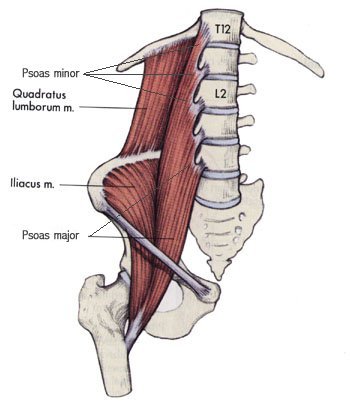
Last month I showed you a great stretch for the hip flexors, specifically the iliopsoas muscle.  The high lunge stretch I demonstrated is excellent for hitting the lower fibers of the psoas, while also engaging some of the iliacus fibers as well.

The stretch I demonstrate in the video below will round out hip flexibility by stretching the upper fibers of the psoas muscle.  When done correctly, you should feel the stretch up higher into the belly and high groin areas.  You will also need to do a pelvic tilt, so mastering that move will be key in getting the best stretch of the psoas.

Remember that the psoas muscle is a major player in some low back pain syndromes, very often causing a referred pain along the sides of the spine, and could go up as high as the lower mid-back.  The psoas as a source of low back pain is often missed by practitioners, who’ll work on the low back muscles, unfortunately to no avail.

Always the smartest thing to do if you have low back pain is to go see a doctor–preferably a sports chiropractor.  But if you know your psoas is tight and playing a part in your low back pain, then by all means do this stretch.  If stretching the psoas doesn’t seem to provide any relief, then make sure you get in to see your chiropractor right away.

Watch the video below to get the best instruction of stretching a tight psoas muscle.  And for those of you that know this stretch–yes, it is also know as a “runners stretch”.  Enjoy.

Previously I showed an exercise called abdominal hollowing, which as I explained is essential for strengthening the abdominal core.  A strong core leads to stabilization of the low back through a tightening of the musculature surrounding the area, as well as through the tightening of the thoracolumbar fascia.

Another exercise to help strengthen the abdominal core, as well as assist in stretching the hip flexors, is called pelvic tilting.  A pelvic tilt is bringing the pubic bone and belly button closer together.  It essentially engages the psoas major muscles to either pull them out of the equation as a contributor to abdominal crunches, OR to get a better psoas stretch during the hip flexor lunge or runners stretch.

Watch the video below to get a handle on pelvic tilting.

Copyright © 2013 Dr. Nick Campos - All Rights Reserved.