
Currently viewing the category: "water"

Not a nice story, but a sobering reminder of the importance of staying hydrated.  Sally JoAnne Menke, a longtime editor for Quentin Tarantino films was found dead early Tuesday morning, a victim of hyperthermia or heat stroke.  


Menke went out walking her dog with a friend at around 9 am Monday morning in Griffith Park in Los Angeles.  For those who don’t know, Monday was a day of record heat in Southern California, reaching 113 degrees in Los Angeles.   During the walk, Menke, who had a history of seizures, started complaining of dizziness; she decided to return to her car.  The friends split up, and Menke was observed walking on a hiking trail about 15 minutes later.  Witnesses say she appeared disoriented but declined any help.  Apparently, Menke and friend did set out on their hike with a bottle of water.  


When Menke failed to turn up after the hike, friends organized a search team and set out on horseback and by foot to find her.  By 6pm the police were called.  Search dogs, a police helicopter, Hollywood Division officers and the Fire Department’s urban search-and-rescue squad participated in the search.  Her locked car was found in a Griffith Park parking lot.  Menke’s body was found at 2:15 am at the bottom of a ravine near 5600 block of Green Oak Drive with her black Labrador retriever loyally by her side.  She was 56 years old.

Menke worked on every Tarantino film from Resevoir Dogs to in 1992 to last year’s Inglourious Basterds, which earned her an Academy Award nomination.  She also worked on Teenage Mutant Ninja Turtles, Heaven & Earth and Mulholland FallsMenke leaves behind two children, a son and a daughter.
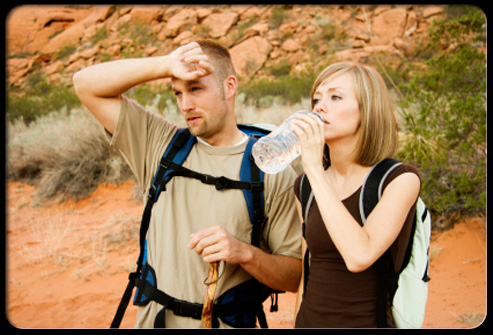
This is a sad story that is a major reminder to everyone: Don’t mess around with your hydration levels.  Water is necessary for most life processes, with temperature regulation a crucial one.  We have a very intricate temperature regulation system that is dependent on water.  When hydration levels are low, we become susceptible to overheating, or heat stroke.  Disorientation, dizziness, fatigue, muscle weakness can all occur in an individual that is not properly regulating temperature.  In these individuals, they feel that they just need to lie down and  rest.  Bad idea.  It’s the sleep you may never wake up from.

If you find yourself in this situation, call 911 immediately.  Time might have saved Ms. Menke.  But even better, make sure you are properly hydrated from the start.  That requires two liters of water every day!  That’s right, two liters…daily. Can’t stomach it?  Better build up to it, because it’s what you need.  It doesn’t matter if you live in Southern California or the east coast, Florida or the Great Lakes–regardless of region, you can fall victim to hyperthermia (heat stroke) whenever you are not properly hydrated.

Water intake is not a game.  Don’t mess around.  If you don’t want to eat, you’ll survive, but if you don’t drink water, you’ll die within days.  You might even die sooner depending on conditions.  And don’t rely on your thirst mechanism to guide you.  Thirst is one of the last symptoms of dehydration.  Like I said, don’t mess around: drink your two liters of water every day.

My condolences to the Menke family.

Here’s a little story about how politics, helped by the media and popular culture, can influence belief to such a degree that even health practices change. I’m sure nobody reading this is ignorant of the fact that global warming is one of today’s hippest issues, right up there with saving Africa. Global warming is so hip that it threatens to influence nearly every facet of life, from business to engineering to development. But not until now has it touched the health sector.

According to recent reports, global warming may increase the incidence of kidney stones in the U.S. in the coming years. Researchers at the University of Texas estimate that the number of kidney stones will increase by thirty percent over the next few years. Kidney stones are caused by the crystallization of dissolved minerals in the urine, usually from low water levels in the body, or dehydration. The researchers point out that as temperatures rise more people will become dehydrated leading to a higher production of kidney stones.

Well, you’ll get no argument out of me that dehydration is a growing concern. But I have to say, blaming it on global warming is pure, unadulterated horse manure. Let’s try a little more obvious reason, like too many people bypass drinking water for the more accessible and heavily marketed soda pop. Duh! No, no, it must be global warming. Oh heavens Longhorns, can you get less original? The scientists at UT point out that an increase in kidney stones is already being seen in the southeastern belt of the U.S.–that includes Alabama, Arkansas, Florida, Georgia, Louisiana, Mississippi, North Carolina, South Carolina and Tennessee. I’ll bet if the numbers are crunched they’ll show that that region has a super-high imbibition of sodas, sweetened iced tea, and liquor–all of which are highly dehydrating. And I can tell you that all three of those beverages will lead to an increased development of kidney stones. BS Campos…it has to be global warming. Yes, I know.

I really don’t care what method is used to get people to drink more water–I feel it’s that important to human health. But here’s the problem: Just four months ago, the consensus from the scientific community was that the necessity of drinking water was just a myth. Remember my earlier post on the subject? And if you’ve read The Six Keys To Optimal Health, you know that I’m adamant about proper hydration. You would also know from reading my book that some scientists think that drinking water can be harmful to one’s health. And many people watching the nightly news, or listening to their family physicians believe that you can get most of your body’s water through the food you eat (I swear, I’ve heard this nonsense before). Yet today…science has found that proper hydration is now necessary because of global warming?!?! Whatever.

I guess I’m gonna just give in and jump on the ol’ global warming bandwagon. So here goes some health news I’d like to see:

  • Global Warming Causes People to Need More Chiropractic!
  • Global Warming Makes People Vitamin Deficient.
  • Global Warming Reduced by Exercise.
  • Global Warming Caused by Excessive Statin and Antidepressant Use.

Yeah, that’ll be the day.

Spent the day in downtown L.A. fulfilling my civic duty. Jury duty called and I was promptly selected–aargh!

While having lunch in the local food court, I couldn’t help but notice a very interesting observation: about 90% of the people in my view were drinking soda. I am certain that I saw a couple hundred people, so that’s a heck of a lot of soft drinks. I counted a few water bottles, but mostly I saw people drinking out of waxy soda cups, the kind you typically find at fast food restaurants. True, it might have been water, but since I know the national soda consumption numbers, which are astronomical, I’m sure these people were drinking what most Americans choose–good ol’ fashioned candy pop.

I couldn’t help but think about the weight loss industry too; about how it’s booming, and about how promising its future looks. How many people in this country are trying to lose weight right now? How many of you reading this are?

Well I’ve got a real buzzkill for you: You are never going to lose weight if you don’t give up your sodas. I know, I know–eff you, Campos!–because people feel strongly about their soft drinks. Never have I received so much resistance when suggesting a habit kick than when suggesting people stop drinking soft drinks–not from smokers, not from heavy drinkers, not from heavy sushi eaters. Nope, soda drinkers beat them all. They come up with all kinds of reasons why everything but soda is bad for them. Soda is not that big of a deal. Yeah, right.

I used to drink soda, I get it. You can pound these things all day long. Some people nail six or more in 24 hours! That’s pure, unadulterated liquid sugar. No nutrients, no vitamins–pure calories, pure sludge. I’m telling you, you can watch every other thing you eat. You can work out seven days a week. You can get liposuction and a stomach staple. But if you keep drinking sugar, you’ll never lose weight. I’ve been there, done that. Believe me soda is the first thing you must kick if you’re ever going to drop pounds. Next is booze, but that’s another story (don’t worry, I’ll get to it one day).

Here is the scary thing: Most people I observed at the food court seemed to be employees of the legal court. I know because I followed a bunch of attorneys down there; figured they’d know the best place to grub. They did. But no way I could eat that way every day. However, as I clearly saw, many people in downtown L.A. do. I didn’t see many other places to eat in the area. Funny, but my pompous L.A. arse always assumes that we know better in this town, but clearly we don’t. I can’t even imagine what it’s like in other less health-conscious cities like Houston, Oklahoma City or Vegas.

So here’s the skinny: If you wish to lose weight, drop the sodas, man; it’s the only way. But if you love your sodas so much that you can’t kick the habit, then don’t be so hard on yourself–enjoy your coke and your smile, and just be content with the extra 20 pounds.

I just love when these stories come out. You know, the ones that say a particular physiological fact is false. Take, for instance, the claim that taking vitamin supplements is unnecessary. Always the claim, “…there’s no proof.” Or how about the efficacy of chiropractic–“…no proof.”  Yeah, yeah, the proof’s there–it’s in the pudding as they say.

But back to the silly notion of claiming certain physiological facts to be untrue. A new study published in the Journal of the American Society of Nephrology apparently “debunks” the myth that drinking lots of water is better for your health. I tell you I just love these stories. Start off with a subject matter that is fact–All living things need water to survive–add a corollary which is nonsensical, and then disprove it. Next take the faulty conclusions derived from the debunking, and use them to deflate an entire principle, one which we can easily deduce as true. The only thing I don’t get is…why? Well, let’s figure it out.

Two nephrologists (kidney doctors) out of the University of Pennsylvania have “reviewed the scientific literature” and have found no conclusive evidence that drinking more water equals better health. Oy vey. First off, the idea that drinking “lots” of water is healthy is absurd. It is quite well known that one can drink too much water. This can lead to hyponatremia–low sodium concentration–which can kill you. So there probably isn’t any credible health care practitioner recommending this practice. “Hey Vern, drink five gallons of water every day–you’ll be Superman.” It’s so stupid, it’s almost embarrassing; but clearly it has to be addressed.

Then there’s the idea of drinking “more” water. More than what? Do the esteemed researchers mean more than necessary? Well then, of course one doesn’t need to drink more. Is it too much to ask of our scientists but to pose viable questions? Because if we are talking about the average American, the one that imbibes soda more than any other beverage, then the notion of more water probably means “more than what you’re drinking now.” As even the two medical investigators point out in their paper: people who live in hot, dry climates, athletes, and people with certain diseases do better with increased fluid intake. So, basically, we can extrapolate these facts to anybody who exercises, sweats a lot, takes meds that make them urinate (diuretics), drinks beverages that make them urinate (coffee, tea, alcohol), or in other words…just about everybody.

Wait Campos. That’s not true. No evidence.

What evidence do we have? That they haven’t done any significant studies on hydration levels of populations; nor have they done any looking at the effects of water replenishment in people who are subclinically dehydrated (read my book); nor have they done any measurements on organ function or dysfunction at different hydration levels. But they have looked at hydration levels and endurance in athletes. Did the two doctors look at these studies? I know, I know, those are athletes. But I think it applies to everyone–we just don’t have the studies showing it, yet. And because it would simply be dangerous (and thus unethical) to knowingly deprive humans of water (can you guess why?), we probably will never see those studies.

So here’s my problem: Why even publish such rubbish? I mean, even the authors admit that, “If someone enjoys it…that’s wonderful, keep doing it. They’re not doing anything that’s going to hurt them.” Bingo! So why bother? If what they say is true, then why go through the trouble of debunking a so-called myth. I really don’t know; but I can tell you one thing: the doctors who wasted their valuable grant money putting together this deficient drivel didn’t really think about water’s full role in the body, or in life itself. They certainly didn’t ask any revealing questions. All they did was ask if certain beliefs about water had been studied, and found that they had not–that’s all. They didn’t prove or disprove anything about this elixir of life. But, unfortunately, they are passing their findings off as an unveiling of great truth; and I just don’t think they’ve come anywhere close.

I know nobody in L.A. drinks tap water–it’s bottled water for everyone. However, all Los Angeles residents need to be aware that the Metropolitan Water District is adding fluoride–a known toxin–into the city’s water supply. Water fluoridation has been a topic of controversy for decades, and L.A. water has gone unadulterated for years, but not any longer.

As of last month, fluorosilicic acid has been added to L.A.’s water supply in an attempt to decrease dental caries (cavities). Fluorosilicic acid is a known poison, even in small amounts. Proponents–the American Dental Association, the American Medical Association, the World Health Organization and the Centers for Disease Control and Prevention–believe that minute amounts help in fighting cavities. But fluorosilicic acid is highly unstable; that means it dissociates in water. It is potentially linked to skeletal fluorosis (check out some gnarly pictures, here), bone cancer, thyroid disease and other diseases. It is so toxic that an accidental spill of fluorosilicic acid on a Florida interstate a few years ago sent more than 50 people to hospitals. According to the Los Angeles Times, “Drinking an ounce would probably kill a person.” Yet, we are being fed this stuff by health organizations and government as a health remedy. Doh!

I spend quite a bit of ink on this topic in my upcoming book, The Six Keys To Optimal Health, collaborating with an expert in the area to get much of my information. No surprises how I feel about it. Despite the purported benefits, many European countries have bypassed the practice and continue to have low rates of tooth decay anyway.

If you don’t mind having a known toxin added to your drinking water, or you think it’s a good thing, then do nothing–ignore this post and move on. But if you think like Martin Sheen that “We are not lab rats and reject any attempt to be treated as such,” then you might want to keep informed and do what you can to stop the practice. That’s all I’ve got to say…for now.

Check out 50 Reasons to Oppose Fluoridation.

If it ain’t enough that sugary drinks (read: soda, diet soda, juice cocktails, and energy drinks) contribute to obesity, a new study shows that they may also increase the risk of high blood pressure, heart and vascular disease, as well as metabolic syndrome – all of which may lead to diabetes and heart disease.
A new study shows that sugary drinks can lead to higher uric acid levels, which, in turn, can lead to disease. It is no surprise that soda is the number one drink Americans choose, even ahead of water, but here go some more interesting statistics. People who drink more than one soda a day have:

  • 31% greater risk of becoming obese.
  • 30 percent increased risk of adding belly fat.
  • 25 percent higher risk of developing high blood triglycerides or high blood sugar.
  • 32 percent higher risk of having low HDL (good cholesterol) levels.
And now, as we are learning, higher uric acid levels. Uric acid is the body’s natural breakdown product of protein. When blood levels of uric acid are high, it can lead to disorders such as high blood pressure, heart disease, diabetes, kidney stones, gout and more.
These conditions don’t happen over night, so if you are a soda drinker, you can halt their progression by cutting down or quitting soft drinks altogether. The reality is that soft drinks provide nothing by way of nutrition – and they certainly don’t get you drunk – so my question is: Why?
“Well they taste good.”
They taste good?
“Yeah. They taste good.”
Sheesh. At the risk of standing on a pulpit, here. Aren’t good tasting things supposed to be occasional treats. We’re drinking this stuff more than water. Did you know that without water there would be no life at all? Anywhere?
How can we drink more soda than water? I’m sorry but it’s beyond me. Please enjoy a soda now and again, but, well, we all know at least one person who drinks three, four, even six cans of soda per day. Is anybody still perplexed as to why obesity is epidemic in this country? Still scratching your heads over America’s world health rankings? I promise you’ll be hearing more about soda’s ill effects on health in the years to come. But fear not Coca-Cola shareholders – soft drink companies will not be going out of business anytime soon. Heavens no. They’ve already firmly established themselves in the next big market – bottled tap water. Stay tuned for more.

Welp, they almost got it right. Medical science is working very hard to jump onto the wellness bandwagon. There was a time when the term prevention was considered an “alternative” concept – that is, medical science placed very little stock in the idea of practicing preventative measures. But not anymore. Oh no. Not only is it very hip (medically speaking) to promote prevention, but now mainstream medicine is trying to form the term to fit within its own paradigm.

Imagine my excitement when I caught the headline, Preventive steps could save 100,000 U.S. lives: study. What? Do my eyes deceive me? Is the mainstream medical information machine really going to push the same agenda as I do with The Six Keys To Optimal Health? Wow, cool man. Let me check it out.

Hmmm. Not quite. But I guess it’s a start. The premise of the article is that if people were to take preventative measures, such as taking an aspirin every day, quitting smoking, getting more colorectal exams, getting more mamograms, and getting annual flu shots, then many life threatening diseases could be averted. OK, that’s true. But is that the gist of prevention? What about health, I mean, that surely can’t be all there is to it, can it?

Heck no. And the problem lies within the philosophy of our current health paradigm, which is: you are fine until you have symptoms, and when you do, you’re sick, and then you’ve got to be treated for your particular illness. All right, we know that one. It’s been in place for at least a century, so we’ve all been there, done that. And we ain’t gettin’ any healthier, now, are we? No, but we do have an overloaded medical system, which creates quite a problem.

I’m not going to go into all the details of why our current system doesn’t work and how we can change it into something more useful. Let’s save that for my upcoming book, The Six Keys to Optimal Health. You’ll find that I do a very thorough job of dissecting the current health paradigm and how we can now take our understanding of health to the next level. And based on the studies coming from our current health authorities, I can assure you the change isn’t going to come from that camp any time soon.

Instead, if I were to rewrite this study, it might read something like this:

Increased use of just five preventive services would save more than 100,000 lives every year in the United States, and they are:

These tips are just a small taste of what you’ll find in my upcoming book, and I’ll provide the information to prove them. You better believe that. When you’re done, you won’t even think about prevention, because if you do things right, there will be nothing to prevent.

Copyright © 2013 Dr. Nick Campos - All Rights Reserved.