Currently viewing the category: "smoking"

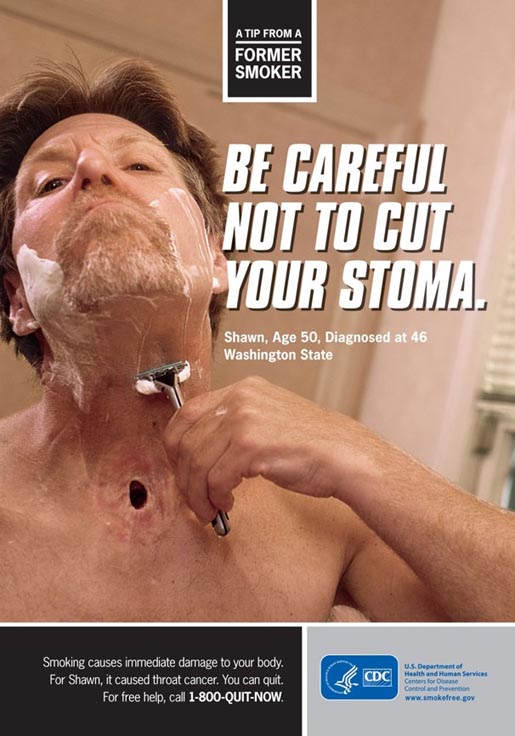
I don’t usually care for commercials, but they got me on one today. I usually get pissed when I have to wait five seconds to skip an ad…and those sly marketers did it. The simple headline, “Tips From Former Smokers,” grabbed me. What? And from the opening line–it’s genius!

“When you got a hole in your neck, don’t face the shower head.”

Bam! Powerful. And it keeps getting better. If this ain’t a deterrent for smoking, man, nothing’s gonna stop ya. Yeah, it worked for me.

Listen up, school boards…play this CDC video for every kindergarten, grammar school and high school in the world if you want to deter smoking. Make them in different languages. Don’t hold back, show the kids–you’ll probably decrease new smokers by fifty percent. G’head–dare ya. And tell ’em Campos told ya.

Some people think we live in a random universe, nothing but probability–a chance for this, and a chance for that. Some also think that health is random. Some people get sick, others do not. A roll of the dice for the most part. In fact, that’s what insurance is for: you purchase insurance hoping that you won’t get sick, but if by chance you do…

This approach to health, however, is foolish. We know that health and wellness are not random. What we do regularly determines whether we will experience health or not. It certainly is about probability when it comes to our health. The more we engage in healthy behaviors, the greater the probability we will remain healthy; and the more we  engage in unhealthy behaviors, the greater the probability we will develop illness or disease. True, it’s never one hundred percent, as Jim Fixx showed that any fitness enthusiast can drop dead from a heart attack, while George Burns smoked cigars into his 100s. Go figure.

But what we do is still the most important determinant of health. Take a recent study that now shows 50% of all cancers are preventable. That’s right folks! And the big C is the second leading cause of death following another preventable condition…you got it–heart disease.

The numbers one and two killers in the U.S. are preventable. Smoking is blamed for 33% of all cancers, while 75% of lung cancers are due to smoking. Shoot, I used to smoke, I get it. I liked smoking, heck yeah…but I quit. Simple as that. My cancer risk went way down. Probabilities.

Here’s another: Obesity is responsible for 20% of all cancers in the U.S. Throw in booze, pollution, poor diet, prescription drugs by the pounds… Why, heck…of course cancer is the number two killer–people are poisoning themselves.

And the political perspective is that these people just don’t have enough resources. State smoking cessation programs are being financially undercut, and people don’t have money, or the insurance, to be treated once they get sick. Random.

But by quitting smoking, eating well, minimizing junk food (like sodas), and exercising regularly actually helps lessen the risk of heart disease and cancer. Not random.

Duh.

Listen up parents: Sports participation may keep your adolescent child from smoking.

Listen up parents: Sports participation may lead your  adolescent child to smoke…especially your daughter.

Huh?

That’s right–both are conclusions of a recent study on peer influence conducted out of the University of Southern California. According to the research, middle-school children involved in organized sports were less likely to smoke than their peers. Nice. However, if their teammates smoked, then preteens were more likely to do the same, and the results were more pronounced among girls. Talk about smelling like team spirit.

Researchers questioned 1,260 sixth through eighth graders about their smoking behavior. The children were middle class, lived in urban areas and ethnically diverse.

The researchers concluded that peer leaders, especially in athletics, could help influence kids to avoid the stinky habit.

“Current guidelines recommend the use of peer leaders selected within the class to implement such programs,” said Kayo Fujimoto, the study leader. “The findings of this study suggest that peer-led interactive programs should be expanded to include sports teams as well.”

No doubt individuals of a group are going to influence one another–it’s called group cohesiveness. And no group more cohesive than the athletic team.

It really does make sense, then, to address health issues with both girls and boys as a team. If you can get through to one, you might just be getting through to all. But I am certain it’s best to start teaching ’em young, and to not be too obtrusive about it. Anything pushed too hard on the adult end is bound to stir curiosity. Listen, if my parents and teachers said it was bad, then it was good as far as I was concerned.

A better approach is to teach children about various health risks–like smoking, boozing, or sex (especially unprotected)–by just giving them the facts, without added emotion. This is smokers lung, girls; and this here is the result of a drunk driving accident; and over here we’ve got syphilis…and so on. Trust that kids will come to their own conclusions, and believe me, if a few on the team get it, then they probably all will.

But mostly it starts in the home, folks. If you smoke, your kid will probably smoke too. If you drink soda, your kid will probably drink soda. And on and on

Remember, there’s no I in team, dammit. So teaching the kids, especially peer groups, about healthy habits, without shoving it down their throats, will likely get through the best. Good work, team.

You want me to let you in on a little secret? It’s called dumb doctoring. Here’s how it works: Patient comes into doctors office with symptoms. The symptoms are of a normal physiological process gone awry. Doctor prescribes medication to relieve the symptoms, ignoring the cause (usually a faulty lifestyle habit). Patient gets relief as long as the medication is continued (lifestyle drug), but then develops more symptoms related to the long-term drug use. The patient goes back to the doctor with new symptoms…and gets more medication.

But where does it end?

Well let’s see. How about I finish the story like this: Um…study comes out…yeah, uh…showing that…the medication used to treat initial symptoms…uh, increased the risk of hip fracture! Yeah, that’s it–better than a freakin’ movie of the week, because IT”S REAL!

A recent study shows that women who take popular heartburn and indigestion medications (read: commonly prescribed) may put themselves at a higher risk for hip fractures. Long-term use of proton pump inhibitors (PPIs), may increase that risk by 35-50% for current or former smokers. Prilosec, Nexium and Prevacid are some examples of these heartburn/indigestion medications.

Can I give you some Prilosec?

Dr. Hamed Khalili, clinical and research fellow in gastroenterology at Massachusetts General Hospital in Boston, and lead researcher of the study says that postmenopausal women, particularly with a history of smoking should be closely monitored on these drugs. These results coincide with a recent FDA revision of labeling of PPIs “to incorporate concerns about a possible increase in risk of fractures with these drugs,” he said.

Khalili’s team looked at over 80,000 postmenopausal women over the course of eight years, from 2000 to 2008, and found that nearly 900 hip fractures occurred–with a 35% increased risk for women using PPIs compared to women who didn’t take the drugs. And the increased risk of fractures among women who smoked was even higher, reaching 50%. The longer a women took a PPI, the more her risk increased.

But back to dumb doctoring. The data showed that the number of women in the study taking PPIs increased from 6.7% in 2000 to 18.9% in 2008. Duh! Couldn’t the dumb doctors have gotten the numbers higher than that?! Consequently, the researchers expect hip fractures to rise even further in upcoming years.

What’s so laughable about this story is that it’s simply an everyday occurrence in the world of modern medicine. The story I described above is the way it’s done in 99% of medical practices in the country (g’head, prove me wrong). The only fools not seeing it are the doctors themselves; so blinded are they by their backwards ideology.

Listen, drugs are useful–but in moderation! Short-term drug use is best, Trapper–not a freakin’ decade-long habit. Duh! But that’s what we call dumb doctoring here in the western world. Most indigestion and heartburn issues are diet related. The body responds to foods it doesn’t agree with (or activities, like lying down immediately after eating, or smoking) with acid reflux. The long-term answer is not drugs! On the contrary, it’s finding the real cause and correcting it. But oh no…that would be far too much work, wouldn’t it?

And when patients return with more symptoms…? Why, let’s give ’em more drugs. May I repeat…DUH! And people of the general public you are not off the hook, either, because you don’t ask yourself why? Why does the body respond with heartburn for months…years? You think it’s normal? You think you just don’t have enough drugs in your body?

I know that not everybody cares about maintaining health–that many people want to just live their lives and deal with their illnesses as they come. I get it–I really do. But I also know that some of you reading this do care about your health, because it allows you to live more fully; it allows you to do the things you love. So this post is really for you. If you have symptoms lasting for more than a couple of months, then just understand that you are disrupting your body in one way or another. No biggie–find out what it is and make the necessary changes, that’s all. But understand that if you ignore it; or worse if you ignore it by quieting it with drugs, but never really solve the problem, then you will pay later. And not that much later, either.

As for you dumb doctors–whoops, your bad. Maybe no one will notice…

Flash, this just in: Only 10% of American adults have low heart disease risk. You heard right, nine out of every 10 people in the U.S. have at least one risk to their heart health; and the worst part is that these risks are all lifestyle dependent. Not good for a nation bent on pointing the finger at external causes for its poor health rankings.

According to researchers from the Centers for Disease Control and Prevention (CDC) that looked at four national studies covering tens of thousands of Americans aged 25 to 74, only ten percent had low risk in the following categories:

  • high blood pressure
  • high cholesterol
  • high blood sugar
  • overweight
  • smoking
  • exercise too little

Each one of these categories is significantly impacted by lifestyle behaviors. High blood pressure, cholesterol and weight can all be controlled with regular and moderate exercise. Regular. Three times per week, minimum. Are you doing that?

High blood sugar and weight is directly related to the amount and types of food we eat. The U.S. has a morbid addiction to sugar. I’m not talking just desserts here–oh, we’ve got that too, but what I’m talking about is sugary regular foods: cereals, canned foods, ketchup, BBQ sauce, French toast, scones and muffins for breakfast, and the worst of all–sodas! Hey I’m guilty too, because I have recommended sports replacement bars to my readers. No more! That stuff is sugary shit. I don’t eat them, and I’m not going to recommend them to anyone else, anymore. Pure crap.

And the portions we eat are obscene. We all put away way too much every time we eat out. Sorry, but them’s the facts. Too much food.

And smoking? Like my good friend J.C. says, “Smoke ’em if you got ’em.” But just don’t point the finger at anyone but yourself when it’s time to pay the piper.

This is what really gets me irked about people: A full 90% of citizens are not doing all they can to care for their health, yet somehow it’s somebody else responsibility to take care of them if they fall ill. Sorry, but nobody can do your push-ups for you, no matter how much you demand it.

When it comes to teaching children healthy habits, what is the best thing parents can do to help their cause? You guessed it–practicing what they preach.

A new study that observed more than 1,300 families showed that when parents up their consumption of fruits and vegetables, so do their kids. No surprise here. As I’ve said before: Kids do as their parents do. Drink lots of soda–expect Junior to drink lots of soda. Watch lots of T.V.–expect Muffin to watch lots of T.V. Bypass the gym and blow up–well, you get the point.

But isn’t it refreshing to know that you can influence your children in the positive, too? All you have to do is adopt healthy lifestyle habits: eat fruits and vegetables, can the sodas, exercise regularly, get chiropractic care, rest up, and kick the smoking habit. And most important–believe in it! I promise you, whatever your children see you do regularly will be what they do too. You can bet on it. Doesn’t it make sense to pass on healthy habits to your children? Don’t make poor health choices your family legacy. Do the right things and your kids will too.

Check this out: If you’re a smoker–and a woman–and you quit, you’ll reduce your risk of dying from a smoking related condition significantly over the next five years. You’ll also cut your chance of developing a smoking related cancer by 20% within that same time period. So says the Nurses’ Health Follow-Up Study that looked at 104,519 female participants covering the period from 1980 to 2004. Nice.

I’m really not that much of a “you better quit smoking” person. Weird, huh? Being a doctor and not feeling adamant about banning smoking. Well, I just don’t. I smoked for 20 years and I know its got it’s draw. I also know that cigarette smoking isn’t the only thing that can kill you–pretty much everything can. I mean, we’re all going to die, aren’t we? Case in point: More women who didn’t smoke died in the study (4,485) than both smokers (3,602) and former smokers (4,396) during 1980 and 2004. Yes, this study is ongoing, and has been since 1976, so many of the non-smokers who died were probably older. But that’s not my point: we all die.

For me, dying isn’t the most important issue, though; it’s quality of life. And I can assure you that the quality of my life has improved dramatically since I quit smoking cigarettes. I have more energy. I’m sick less. I can work out harder. My lungs feel stronger and full of air. The list goes on and on. If you smoke, and you have since your childhood like I had, then you won’t know what I’m talking about until you quit. It’s better, trust me.

But, hey, some people can smoke occasionally (very few). If you only smoke once in a while, then you probably get the best of both worlds (kudos, cigar aficionados). But for most people tobacco is addicting, and they’ll enjoy a better quality of life by kicking the habit. And if you really do give a hoot about quantity of life, then you’ll be happy to know that according to the study: being smoke free for 20 years reverts a person to a physiological state of having never smoked at all. Isn’t the human body amazing?

Am I seeing this right? Are studies now showing that smoking and obesity might have some benefits after all? Researchers are reporting that smokers are at a lower risk for developing Parkinson’s disease, while obese people who have heart disease live longer than their non-obese counterparts. What!?!? Now let me get this straight, two pillars of conventional health wisdom might be partial truths? Whaddaya know.

Check this out: 11 studies conducted between 1960 and 2004, looking at over 11,000 people, showed that current smokers had the lowest risk of developing Parkinson’s disease, while former smokers, some having quit as long as 25 years earlier, showed the next lowest risk. Scientists are not quite sure what provides the preventative effects, but they extend to cigar smoking, pipe smoking and chewing tobacco as well.

Regarding obesity: among 6,900 men with symptoms of heart disease, researchers found that those who were obese were less likely to die over the next seven-and-a-half years compared with normal-weight men. Some studies also hint that obese people may survive heart bypass surgery better.

Now this doesn’t mean that we should all pick up a pizza, beer and Marlboro lifestyle habit, but it does bring up a very important point. We still know very little about the workings of the human body. According to one of my former professors, we probably know about 40%, and I think this might be a generous estimate.

What’s the significance? Nothing we know today is 100% definite, so proceed with caution. Don’t just accept health information as it comes; think about it, be discriminating. As I like to say: today’s conventional wisdom is tomorrow’s obsolescence. You’ll be the safest if you practice the basics – The Six Keys To Optimal Health. These are tried and true principles, which haven’t changed for thousands of years – they’re timeless. So, instead of banking on Viagra, Lasix or Botox, how about caring for your health as your most important asset? You simply can’t go wrong that way.

Copyright © 2013 Dr. Nick Campos - All Rights Reserved.