Currently viewing the category: "diabetes"

Duhhhhh….does soda make you fat? Don’t know…but it might make you dumb. So says a recent study out of the University of California, Los Angeles, which observed what happened when rats were fed a steady diet of high-fructose corn syrup (HFCS), the principle constituent of soft drinks.

Researchers trained 24 rats over a five day period to complete a complicated maze (Barnes maze test, feeding them standard rat chow. They then randomly assigned the rats into four dietary groups: half receiving HFCS as their main beverage source, and half receiving water. Each group was then split into two, those with added omega-3 fatty acids to their diet (rat chow) and those without, so that the four groups looked like this:

  1. high-fructose corn syrup (HFCS) only
  2. high-fructose corn syrup (HFCS)  + omega-3s
  3. water only
  4. water only  + omega-3s
All four groups continued receiving powdered rat chow throughout (with or without the omega-3s). The results showed a few interesting things. First, although there was no difference in final weight or size of the rats, the HFCS groups preferred eating the sugar to the rat chow–they must have been American–although caloric intake stayed consistent among all the groups.

Second, although the rats were found to be in the same initial cognitive condition prior to their special diets, after six weeks the rats that were deficient in omega-3s showed a decline in memory, and thus a reduced ability to complete the maze. Hmmm…. And the results were even worse for the rats deficient in omega-3s and high in HFCS.

But even more interestingly is that the cognitive deficiencies (memory loss) were ameliorated by adding omega-3s to the diet. Whoa!… The researchers conclude that omega-3 deficiency led to a vulnerability of the rats’ brains to the high fructose corn syrup. Fascinating.
“The DHA-deprived animals were slower, and their brains showed a decline in synaptic activity,” said Fernando Gomez-Pinilla, a professor of neurosurgery at the David Geffen School of Medicine at UCLA. “Their brain cells had trouble signaling each other, disrupting the rats’ ability to think clearly and recall the route they’d learned six weeks earlier.”

The researchers believe that the lack of omega-3s caused the brain to become insulin resistant, which would increase the sugar concentration in the blood. This sugar dysregulation then, they think, disrupts the brain’s ability to process sugar, a necessary food source for the brain to process thoughts and emotions.

“Insulin is important in the body for controlling blood sugar, but it may play a different role in the brain, where insulin appears to disturb memory and learning,” Gomez-Pinilla said.

High-fructose corn syrup is commonly found in soda, condiments, applesauce, baby food and other processed snacks. The average American consumes more than 40 pounds (18 kilograms) of high-fructose corn syrup per year, according to the US Department of Agriculture.

“Our findings illustrate that what you eat affects how you think,” said Gomez-Pinilla.

“Eating a high-fructose diet over the long term alters your brain’s ability to learn and remember information. But adding omega-3 fatty acids to your meals can help minimize the damage.”

So the take home lesson here is two-fold: One, and for me the most important, is to make sure you are getting sufficient omega-3s in your diet. Because the typical western diet is high in omega-6s and low in omega-3s, then supplementing, in my opinion, is the best bet.

And two…HFCS is garbage! I’ve been saying it for over a decade, and nothing’s come along to alter my opinion. The typical American is both omega-3 deficient AND consumes too much HFCS. Think about that if you still can…

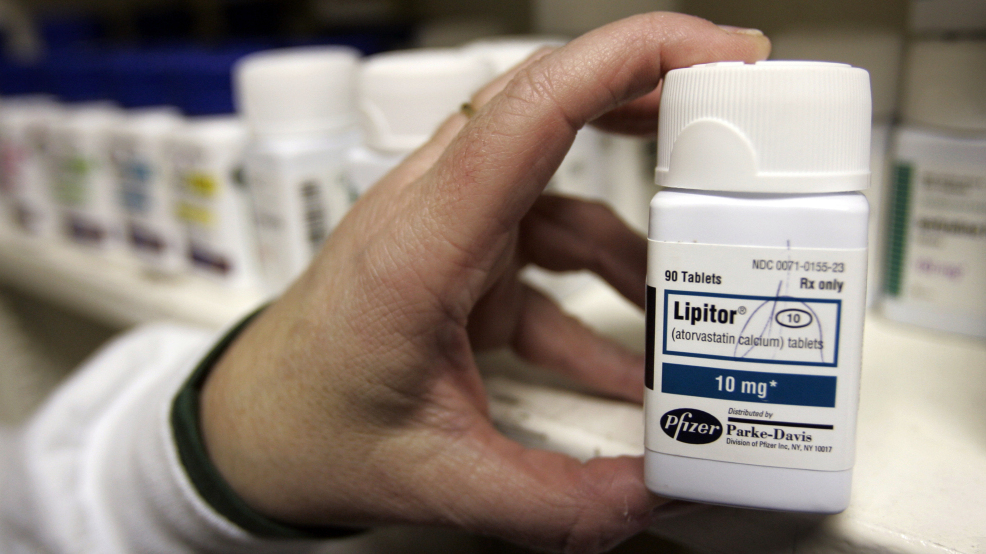
Well, well, well…didn’t I just say so? Looks like statins–those mega-popular cholesterol lowering drugs pushed by every general practitioner in existence–are getting new safety warnings about risks of memory loss and elevated blood sugar. You don’t say? Why yes, looks like the ol’ magic-bullet is being knocked down a notch or two, and with good reason.

The Food and Drug Administration (FDA) reports that it’s making labeling changes to the statin drugs–like Lipitor, Crestor, and Zocor–that will warn of memory loss and confusion reported among certain patients taking statins. Although the feds reassure us that the brain effects are not permanent–apparently going away with discontinuation of the drug–still they find it best to label the drugs to warn us of the potential for waking up in Niagara Falls with no recollection of how we got there. Doh!

Further, the updated labels will also mention elevated levels of blood sugar, associated with diabetes, that have been reported in some patients taking statins. Wait…early onset Alzheimer’s-like symptoms and diabetes?! Wow, get some right away…thanks doc. Yes, although the increased risk is small, an increasing number of studies is showing it’s there nonetheless.

Cardiologists, however, are sticking to their guns, stating that the benefits of statins outweigh the risks. “Patients should not see this as a new danger with the drugs, but as a known abnormality that appears in blood testing and should be discussed with their doctor,” said Dr. Kevin Marzo, chief of cardiology at Winthrop-University Hospital in New York. He goes on to say that he doesn’t see the new warnings making much of a dent in how (read: how much) the drugs are prescribed.

Okay well this much we can assume, doctor; but let me paint a more complete picture for the generally trusting public. What cardiologists mean when they say “the benefits of statins outweigh the risks” pertains to a certain demographic, in reality a minuscule fraction of the tens of millions that are currently taking the drugs. Remember from a 2008 post on statins, the number needed to treat (NNT) for even one person to receive benefit from statins is 100. So in other words, for every person receiving benefit, 99 do not; or in bigger numbers: 9.9 million of every 10 million people on statins gets NO BENEFIT!

So what they really mean is the best ways to lower heart disease risk are (in descending order):

  • Lifestyle modification including exercise, healthy diet, omega 3 fatty acid consumption, healthy vitamin D levels, healthy gut microbiota
  • Statins + lifestyle modifications
  • Statins
  • Doing nothing

What cardiologists assume (and for some people correctly) is that many patients will do nothing. But that’s not you, right? No need to assume the risks associated with statins. Do the right things and you won’t have to, no matter how much your medical drug dealer pushes.

spam-spam-spamYou’ve heard me say: eat at home. You’ve also heard me say: avoid canned, frozen and processed foods. And surely you’ve heard me say to shop on the outer edges of the supermarket, and avoid the aisles. Well here’s a study illustrating exactly why I preach what I do: Native Americans who regularly ate “spam” developed diabetes two times more than those who ate little or none.

The study published in the American Journal of Clinical Nutrition looked at 2,000 Native Americans from Arizona, Oklahoma and North and South Dakota to determine why this group had such a high rate of contracting diabetes. According to researchers, nearly half of all Native Americans develop diabetes by age 55.

Interestingly, spam (generic term for canned meat) seems to be a staple among many in this group. Because many Native Americans live in rural communities, they seek out food that has a long shelf life. Spam is actually subsidized by the government (I can’t make this stuff up).

The study group, whose average age was 35, was all diabetes-free at the beginning of the study. After the five years, researchers followed up and found that 243 of the people had developed diabetes; and they noticed that those who ate the most spam had the highest rate of developing the disease.

Although Spam is a brand-name commercial product, spam is any canned, processed meat. Canned meat is available freely to many Native Americans on reservations as part of the U.S. Department of Agriculture’s food assistance program.

The lead author of the study, Amanda Fretts, said that unprocessed meats did not have the same type of connection to diabetes–that is, people were equally likely to develop diabetes regardless of how much fresh hamburger or cuts of pork or beef they ate.

Despite the data, a causational link between processed meats and diabetes cannot be made. The researchers admit they have no explanation as to why processed meats should cause diabetes. Although spam is higher in sodium, there is no known connection there.

The American Meat Institute, which represents companies that process meat, are sure there’s been some sort of mistake. They have responded to these study results claiming that “processed meats are a safe and nutritious part of a balanced diet.”

Well, I’ll leave it to you to decide–did researchers flub these results and see something that wasn’t really there, or does processed food have effects on physiology that we don’t fully understand? Hmmm…tough call.

The following two posts are not for school districts or their lunch programs–they are for parents. I am writing these posts for individuals, not for the mass consciousness behind government programs. Although I fully understand the utility of mass institutions, like school lunch programs, particularly for people who’d rather not think or act for themselves, I happen to know that some people prefer to take care of themselves–that is, they appreciate certain qualities of life, like what kind of foods their family eats.

I don’t necessarily mean that as an insult, since we all have areas in which we would rather just have help than personally take the bull by the horns. But I am certain that people falling into this category with regard to their children’s lunches–those that would rather subject their kids to school lunches than prepare bag lunches from home–are going to be pissed off by what I have to say. Oh well…

It appears that school kids in Los Angeles are rejecting the new “healthy” meals they’re dishing up at L.A. Unified these days. The L.A. Times reports that the new menus introduced into the public school system as a part of the campaign to combat obesity, diabetes and other health problems has been a massive flop. Not only are kids not biting into the health food fare, but underground junk food markets are popping up at most schools, some even being run by teacher that feel sorry for the starving children. Crazy, I know…but can’t say I’m surprised. I’ll explain why.

First, let’s take a look at some menu items being served at school cafeterias in Los Angeles: black bean burgers, vegetarian curries and tamales, quinoa salads and pad Thai noodles, beef jambalaya, vegetable curry, lentil and brown rice cutlets, quinoa and black-eyed pea salads, and Caribbean meatball sauce. Duh!

Who the heck would eat that stuff? I’m sorry L.A. Unified but that’s beyond stupid. Today’s children, raised on junk food, are not going to suddenly and drastically change their diets, even if First Lady Michelle Obama endorses that yuck. Wake up you brain-dead ideologues–I wouldn’t touch a black bean burger for anything, and I grew up eating healthy food. Sorry, that’s not healthy–it’s puke-inducing.  Listen to what the kids have to say about it

Iraides Renteria and Mayra Gutierrez don’t even bother to line up. Iraides said the school food previously made her throw up, and Mayra calls it “nasty, rotty stuff.” So what do they eat? The juniors pull three bags of Flamin’ Hot Cheetos and soda from their backpacks.  Yeah, no kidding. “This is our daily lunch,” Iraides says. “We’re eating more junk food now than last year.”

And it’s not just the type of foods L.A. Unified School Lunch Programs are serving, but the ways in which they are serving them. Reports are coming back from students and administrators alike of inedible food:

“The chicken pozole was watery, the vegetable tamale was burned and hard, and noodles were soggy,” said one 16-year-old

Other complaints included salads dated Oct. 7 being served on Oct. 17, although lunch program officials claim those dates were not for expiration, but instead “best used by”  dates. Either way, I don’t blame the kids—I wouldn’t buy that either. Who wouldn’t want food to be at its best?

As a result, student participation has been down–thirteen percent to be exact. And as an understandable backlash, the junk food black market has been booming. Students and teachers are coming equipped with candy, chips and even instant noodles to supply the hungry students.

So I reiterate that if children are raised on junk food, like most Americans are, and the food being served in school cafeterias is “like dog food” (according to one student), wouldn’t you expect them to reject it and go for what they know? Duh.

You can’t force drastic food changes on people, let alone children–that’s a recipe for disaster. School lunch programs could start by simply offering good quality foods. So keep the burgers and pizza, just make them with decent ingredients, and not the mass produced crap that large institutions typically purchase. I mean, my heavens, the school lunch budget increased a whopping 900% (from $2 million to $20 million)–start by buying fresh meat instead of frozen pre-made patties.

I like that L.A. Unified is attempting to make school lunches healthier, but serving Sloppy Quinoa-Joes ain’t gonna cut it. They’ve got to keep it within the comfort zone of the children. Fresh fruits and vegetables instead of canned or frozen is a good start, and I’m happy to report they have done that. But before introducing the same sort of yuck they serve at the Whole Foods hot deli counter…I’d invest in barf bags.

More evidence showing the dangers of vitamin D insufficiency, as a large new study shows that people with low blood concentrations of this vital nutrient are at an increased risk for dying of any cause. Any cause? Yes, and even more startling was that  by simply boosting low levels with vitamin D supplementation it cut peoples’ risk of dying in half.

According to the latest study, which looked at 10,899 patients at the University of Kansas Hospital, 70% were deficient in vitamin D, and they were also at significantly higher risk for a variety of heart diseases, including  hypertension, coronary artery disease, cardiomyopathy and diabetes. D-deficiency also nearly doubled a person’s likelihood of dying, whereas correcting the deficiency with supplements lowered the risk of death by 60%.

rickets_boy

Rickets

These numbers highlight previous research that has shown many North Americans to have insufficient blood levels of vitamin D. While Rickets due to vitamin D deficiency has been well understood for years,  the degree to which blood levels of vitamin D play a role in overall health and well-being is just starting to become clear: We now know that levels falling below 30 ng/ml are incompatible with good health.

According to the latest National Health and Nutrition Examination Survey, an estimated 25-57% of adults are vitamin D insufficient, while other studies have suggested the number is as high as 70%.  Cardiologists from the University of Kansas study have found that people deficient in D were more than two times as likely to have diabetes, 40% more likely to have high blood pressure and about 30% more likely to suffer from cardiomyopathy (diseased heart muscle) than people without D deficiency.”We expected to see that there was a relationship between heart disease and vitamin D deficiency; we were surprised at how strong it was,” said Dr. James L. Vacek, a professor of cardiology at the University of Kansas Hospital and Medical Center. “It was so much more profound than we expected.”
Vacek believes that so many people are deficient because they aren’t getting enough sun. Humans should get 90% of their vitamin D from the sun, while only getting 10% from food. We need sunlight to make vitamin D in our bodies, so 20 minutes per day is the minimum necessary exposure to maintain proper blood levels. With the fear of skin cancer looming large, many have taken to using sunscreens to reduce total sun exposure.

130571880-18130246

Experts say that in the Northern United States and Canada the sun isn’t strong enough during winter months to make sufficient vitamin D, even if the weather was warm enough to induce people to expose their skin for an extended period. To combat this seasonal deficiency, adults should get vitamin D levels checked by their doctors, and take vitamin D supplements.
This study definitely comes at an opportune time, as many in the medical field have dismissed previous vitamin D research as inconclusive, particularly the role supplements can play in returning the health to normal (or optimal) for those suffering from deficiency. I have wondered  for some time why so many doctors and med-policy stiffs have been so adamant at denying the research results on vitamin D. The only thing I can think of is that they just despise being wrong. I don’t believe it’s a pharmaceutical industry conspiracy necessarily, as many have been wont to do, but purely a clinging to old, outdated beliefs; really that’s the only explanation that makes sense to me, in light of some pretty solid data. I can certainly understand the uncertainty, but many of the previous studies have been well done, and they are vast in number, so really…what’s the problem?
I just think the old guard will never accept that they were wrong about supplementation from the start, no matter how well-intentioned their skepticism might have been; and I think many are wrong today for advocating minimal sun exposure for the masses. Some increases in skin cancer can be from chronic pharmaceutical use, too, you know…particularly medications that are immunosuppressive. It was easy to blame skin cancer on the sun in the past, but that was wrong. The sun is the most life-giving source in the solar system—avoiding it is just unwise. This latest vitamin D study is simply more evidence to support a universal truth.
You’ve heard of “good” cholesterol and “bad” cholesterol–now meet their wicked stepbrother, “ultra-bad” cholesterol…so bad, it forms stickier plaques, and makes its carrier even more susceptible to heart disease and stroke.  Who’s got this badass sticky-plaque cholesterol?  Diabetics.  But before you think that’s not you…let me add prediabetics to the mix as well.

British scientist have found the super-sticky cholesterol by essentially recreating in the lab.  By glycating low density lipoproteins (LDLs), that is, by adding sugar groups to the molecule, they turned the “bad” LDLs into “ultra-bad” MGmin-LDLs.  The added sugar groups change the cholesterol’s shape, making it stickier and more likely to attach to blood vessel walls.  Once cholesterol sticks to the arterial walls, the plaques narrow the lumen (space), reducing blood flow and thus increasing the probability of heart attack or stroke.  Diabetics and prediabetics are at risk due to the higher levels of sugar circulating through the blood.

Of course, the discovering scientists (University of Warwick in the UK) and the medical community is excited because the findings uncover how a common type 2 diabetes drug, metformin, fights heart disease by blocking the transformation of normal LDL into the super-sticky LDL.  Which of course means greater possibilities for new drugs.

But my interest is from a different angle.  It’s for me to stand on a soap box and say: Please people, listen, decrease your sugar intake or remove it from your diets altogether.  Processed sugar is one of the greatest health impediments of the modern world.  The number of illnesses and organ diseases attributable to excess sugar in the diet are astronomical.

While in doctor school, I read 1,500 pages of pathology text required for the curriculum, and it was my observation that excess sugar (along with tobacco and alcohol use) is one of the primary causes of disease in contemporary civilization.  And our foods are filled with it.  Sugar is in everything!  From cookies and cakes, to sauces, meats, breads, cereals, soups, stews, children’s food…and the list goes on and on.

Fast food is laden with sugar.  But be not afraid…here, wash it down with a soda.  Yes, the American drink of champions!  I know I’m a freakin’ bummer, but somebody has to say it.  Drop the sugary, frosted, high fructose corn syrup-laden CA-RAP before your arteries get filled with super-sticky MGmin-LDLs.  Dang!  Seventy-nine million people in the United States today have prediabetes.  Freakin’ duh!

Let me put it in perspective: You know how you think the guy or gal you see smoking a cigarette is going to have a heart attack one day?  Now you can do the same for the soda drinker.  Think about it.

New York Yankees pitcher CC Sabathia is reporting to spring training 25 lbs lighter.  The secret: He kicked the Cap’n Crunch.  Aw yeh, the former fat-boy is weighing in at a svelte 290, not bad for a 6’7″ frame.  And to think he did it all with one simple change.  Just think of what that might mean for you or your kids!

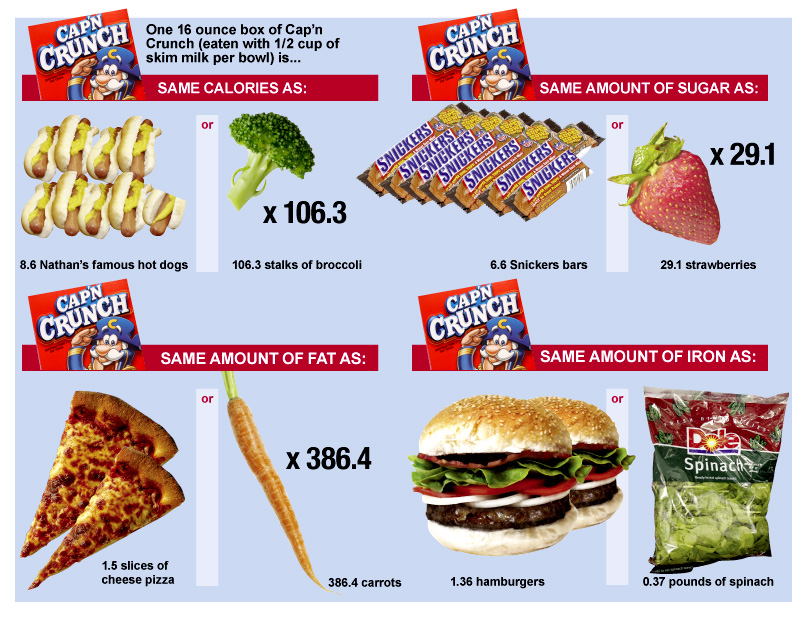
Sabathia, the Yankees ace, weighed in at a whopping 315 lbs last season, when he was knocking down a full box of Cap’n Crunch every day!  Each box of Cap’n Crunch has 12.59 servings, each serving has 12 grams of sugar, making a box of the sugary cereal contain a total of 151 grams of sugar.  Further, the nutritional info on the box lists the number of calories at 217 per double serving.  Therefore, a full box of Cap’n Crunch contains 1,366 calories.  Dang!

To put this into perspective, a soda (Coke, let’s say) contains 40 grams of sugar and 150 calories per 12 oz. can.  More perspective: one teaspoon of sugar equals about six grams; therefore, a can of soda has about seven teaspoons of sugar (see video below**).  Even more perspective: Most sugar packets found in the U.S. have approximately 4 grams of sugar, thus a can of soda contains ten packets of sugar (U.S.).

Now back to Sabathia.  His one full box of Cap’n Crunch a day gave him a sugar equivalent of drinking 4 sodas, 25 teaspoons of sugar, or 38 sugar packets.  Nice, CC…nice.

*A report released in 2009 by the Rudd Center for Food Policy and Obesity at Yale gave Cap’n Crunch’s Crunch Berries the worst nutritional score of any cereal marketed to children and families. ~ from Wikipedia

How about your kids?  Do they eat Cap’n Crunch?  Fruit Loops?  Frosted Flakes?  Do they drink soda?  These cereals and soft drinks have been staples in the American diet for the last fifty years, and it’s not because people aren’t consuming them.  It’s not just 6’7″ professional athletes eating this junk, either.  It’s little Timmy, and little Rainflower, and maybe even you.

Listen, next time you’re thinking about feeding Junior the Cap’n Crunch, why not just give him a Snickers bar?  Same amount of sugar as in a two-serving bowl of the Crunch.  And is it any wonder we are in the midst of an obesity (and diabetes) epidemic?

**Please watch the video below to get great perspective on the amount of sugar contained in a soda:

India’s health minister has an answer to universal health care–it’s called universal yoga. That’s right, the top-dog in the Indian health policy wants all schoolchildren to practice real health care. He wants them doing asanas. Nice. And the rational is that yoga helps prevent conditions such as diabetes and hypertension. Now that’s progressive.

Anbumani Ramadoss, the current Indian health minister, said he would make yoga mandatory for all school-going children, “There should be extensive scientific deliberations on yoga,” he said, “And today I blatantly put that yoga reduces diabetes, yoga reduces hypertension, yoga reduces stress.” True, true, but not all parties agree. The Muslim Malaysian Council or Malaysia’s National Fatwa Council, has sparked protests claiming yoga will steer people away from the religion, causing them to use Hindu prayers, which are considered blasphemous. As a result, the council has put out an edict (fatwa) against practicing yoga. The council also outlaws “gay sex” and women wearing trousers. Holy moly…how primitive.

Well, the religious controversy aside, I think this is one good policy. I’m usually against mandates, but if you’re going to have one, make it yogic. The Indian government could probably do just as well by making it a part of the school curriculum. This will help in a country where diabetes rates are highest in the world–41 million cases in 2007 and counting, and estimates hitting 70 million by 2025, according to the International Diabetes Federation.

Ah, the perils of modernization. Sometimes it’s good to get back to one’s roots–especially when those roots are so good for the body, mind and spirit. Maybe we can take a page out of that health book here in the U.S., and add that to our promised universal health care plan. At least the addition of state supported yoga might actually make a difference.

*Want to know how to do some basic asanas (yoga postures)? Check out this great yoga site here.

Want to know one simple habit that can reduce snacking, increase activity, and help you lose weight? Eating breakfast regularly is what: A study conducted at the University of Minnesota School of Public Health showed that teenagers who ate breakfast regularly had lower body mass index (BMI) relative to their breakfast-skipping peers. And they weighed about five pounds less on average too. Nice.

Although conducted on teens, I believe we can extrapolate the the research finding to adults as well; I mean, the conclusions make sense. According to Mark Pereira, lead author of the study, breakfast eaters probably have better control of their appetites throughout the day, and they are less likely to pick up sugary snacks, like doughnuts, muffins, or scones–items many of us grab on our run through Starbucks.

Think about this for a minute: Who’s more likely to gain weight–people who eat an early morning meal or people who skip it? Duh. It all has to do with blood sugar. Let yours get too low–easy to do if you don’t get fuel first thing in the morning–and your body will surely convert much of your first meal into fat. But guess what? It’ll be the least of your worries. That volatility in blood sugar concentration can lead to diabetes. Diabetes+weight gain/obesity=big problems.

Don’t do it to yourself: Eat a hearty breakfast. Skipping any meal, in my opinion, is a poor dietary practice; but breakfast, especially, should be eaten every day. If the risk of disrupting your blood sugar isn’t enough to get you noshing first thing in the morning, then the thought of packing on the pounds unnecessarily should. In a culture and society prosperous enough for us to even have this choice, we should never take our early morning meal for granted–breakfast truly is the most important meal of the day.

If it ain’t enough that sugary drinks (read: soda, diet soda, juice cocktails, and energy drinks) contribute to obesity, a new study shows that they may also increase the risk of high blood pressure, heart and vascular disease, as well as metabolic syndrome – all of which may lead to diabetes and heart disease.
A new study shows that sugary drinks can lead to higher uric acid levels, which, in turn, can lead to disease. It is no surprise that soda is the number one drink Americans choose, even ahead of water, but here go some more interesting statistics. People who drink more than one soda a day have:

  • 31% greater risk of becoming obese.
  • 30 percent increased risk of adding belly fat.
  • 25 percent higher risk of developing high blood triglycerides or high blood sugar.
  • 32 percent higher risk of having low HDL (good cholesterol) levels.
And now, as we are learning, higher uric acid levels. Uric acid is the body’s natural breakdown product of protein. When blood levels of uric acid are high, it can lead to disorders such as high blood pressure, heart disease, diabetes, kidney stones, gout and more.
These conditions don’t happen over night, so if you are a soda drinker, you can halt their progression by cutting down or quitting soft drinks altogether. The reality is that soft drinks provide nothing by way of nutrition – and they certainly don’t get you drunk – so my question is: Why?
“Well they taste good.”
They taste good?
“Yeah. They taste good.”
Sheesh. At the risk of standing on a pulpit, here. Aren’t good tasting things supposed to be occasional treats. We’re drinking this stuff more than water. Did you know that without water there would be no life at all? Anywhere?
How can we drink more soda than water? I’m sorry but it’s beyond me. Please enjoy a soda now and again, but, well, we all know at least one person who drinks three, four, even six cans of soda per day. Is anybody still perplexed as to why obesity is epidemic in this country? Still scratching your heads over America’s world health rankings? I promise you’ll be hearing more about soda’s ill effects on health in the years to come. But fear not Coca-Cola shareholders – soft drink companies will not be going out of business anytime soon. Heavens no. They’ve already firmly established themselves in the next big market – bottled tap water. Stay tuned for more.
Copyright © 2013 Dr. Nick Campos - All Rights Reserved.